When P3s are used primarily to deliver significant cost savings or risk transfer on an infrastructure project, the goal should be to “optimize” the result in the sense that it’s the first-best solution. In these situations, the private sector has some fundamental advantage in building or operating the project (e.g. proprietary technology or economies of scale in a specialized area of expertise) that the public sector can’t duplicate efficiently.
It’s a great story – and one that the P3 industry naturally likes to advertise.
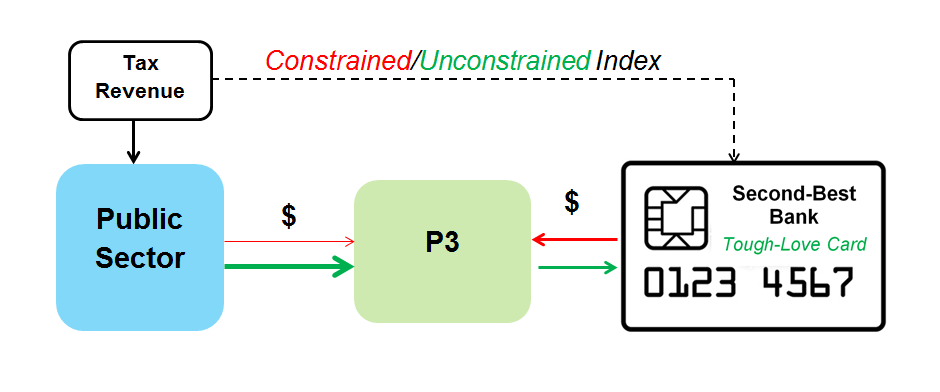
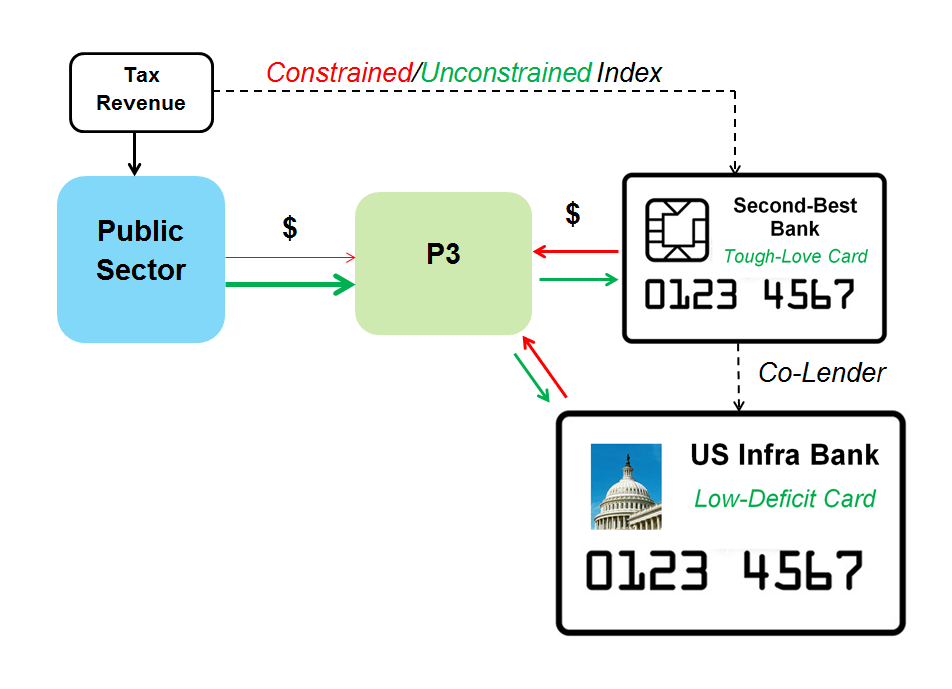
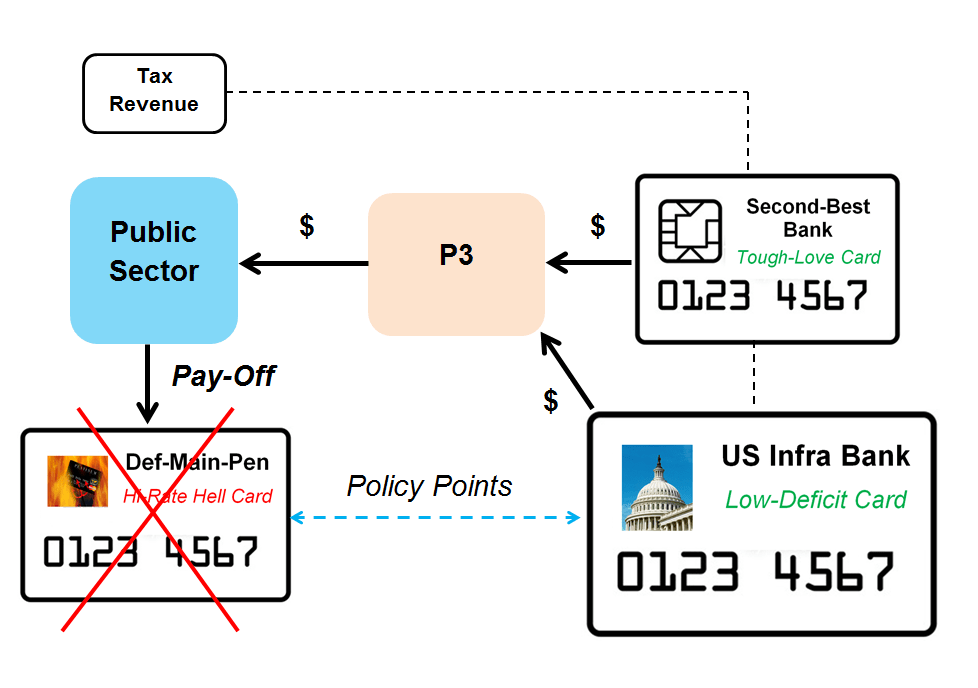
But in many real-world situations, especially involving simple, low-risk social infrastructure, US state and local governments are interested in P3s for a quite different purpose – fiscal management. The contractual and financing forms of P3s can help officials cope with fiscal constraints that impede infrastructure investment like onerous procurement processes, statutory debt limits, volatile revenues and budget shortfalls.*
P3s for this purpose can in fact deliver a valuable result relative to the alternative of delayed investment or none at all, but it’s not a first-best solution (which would involve the really hard job of reforming the constraints themselves).
Worse, “coping” doesn’t sound very glamorous and, described without the context of results, can easily be characterized as gimmickry. So understandably, neither the P3 industry nor public-sector officials are enthusiastic about describing the coping function of P3s per se. Instead, it’s natural to try to spin the story in terms of the classic P3 first-best solution and find some sort of distant cost-savings or hypothetical risk transfer (however nebulous) to justify the deal.**
That’s a real problem, regardless of good intentions. Coping tactics can easily morph into dangerous and addictive gimmicks unless they’re kept on the straight and narrow path by transparency. Here’s a passage from a Volcker State Task Force white paper on budget reforms that puts the matter succinctly (emphasis added):
The budget process is most problematic during difficult fiscal times, especially recessions.
When a state resorts to such gimmicks as shifting payments from one year to the next, underestimating expenditures, or using inflated revenue estimates, it may be doing so both to cope and to preserve the illusion of budgetary balance without raising taxes or cutting programs.
But ensuring that budgets are realistic and that one-time actions are clearly described will
help guarantee those actions are used only when necessary and kept to a minimum.
This is all especially true for coping tactics using P3s because they are complex deals anyway and involve significant long-term commitments. It’s one thing to cope with a revenue shortfall by delaying spending that can made up in a year or two – it’s quite another thing to cope with a debt limit by entering into a 30-year P3 contract on a $250m project. It’s not necessarily bad – but the reasons for doing it that way and the real net benefits need to be clearly disclosed.
Clear disclosure and accessible transparency standards for fiscal management P3s will require some development, since the nature of the beast is somewhat different than usual public-sector commitment. But it’s eminently achievable since at the core of a P3 transaction there’s always a very detailed contract about every conceivable obligation that the public sponsor might have under the arrangement. That’s inevitable and automatic because the private-sector won’t invest otherwise.
So there’s plenty of raw material for transparency in a P3 contract. The challenge is to convert the multi-foot-high stack of paper into meaningful and relevant language and numbers, and then fit these into the standard context of public-sector budgeting and fiscal disclosure like GASB and CAFRs. It may take some work – but a small price to pay for using such a powerful tool as a P3 in a prudent and sustainable way.
The public policy case for more transparency with fiscal management P3s is clear. But the P3 industry should also support the effort. It’s in the industry’s long-term (and larger-scale) interest to ensure that P3s are seen as above suspicion when it comes to gimmickry. If the product really delivers value – even of the second-best, coping variety – then shine a light on it.
*/ Interesting that a former Governor of the Bank of England, Mervyn King, uses the same distinction between “optimizing” and “coping” in his recent book to describe the limits of central bank policy. His point is that in most cases it is impossible to optimize around economic risk using models and stochastic analysis – real-world is far too complex. Instead, central banks should focus on coping with uncertainty with simple robust tools.
**/ I think this is main reason that Value for Money P3 evaluations are often so convoluted and lacking in credibility. When the primary purpose of a P3 is fiscal management, cost savings and risk transfer by themselves are unlikely to make a compelling case when simply and honestly measured. In order to make the case only in those terms (instead of the fiscal management reality), requires unrealistic assumptions, arbitrary adjustments for hypothetical risks and opportunity costs, discount rate games and all the rest. The net result is no one believes the VfM study anyway.